
On this page
Why fascia rots in Duluth
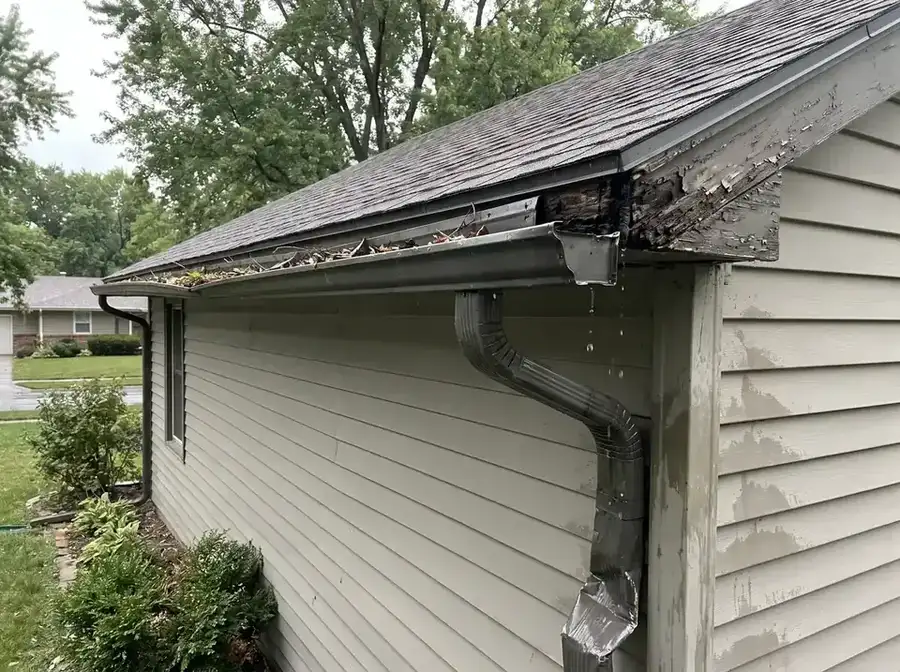
Duluth Gutter Group connects callers with independent local gutter contractors, who give the estimates and do the work. Georgia's long, humid summers keep wet wood wet. Water from an overflowing or leaking gutter, or from a roof with no drip edge, soaks into the back of the fascia, where it cannot dry. Much of Duluth's housing was built in the 1980s and 1990s, when finger-jointed pine fascia was common, and that wood rots quickly once paint fails.
Signs of trouble
| Sign | Means |
|---|---|
| Peeling paint on the fascia | Water getting behind |
| Dark stains below the gutter | Overflow or back-edge leaks |
| Soft wood under a screwdriver | Rot has started |
| Gutter or hangers pulling out | Wood can no longer hold fasteners |
| Holes or sagging in the soffit | Rot has spread; animals may get in |
| Stains on porch ceilings | Water reaching the soffit |
How the repair is done
- Take down the gutter along the damaged stretch.
- Probe the fascia and rafter tails.
- Cut out soft wood back to sound material.
- Fit new board, primed on all sides, or PVC or composite.
- Repair the soffit and vents.
- Fit drip edge.
- Paint or wrap, then re-hang the gutter.
Wood, PVC or wrap?
| Material | Good for | Note |
|---|---|---|
| Primed wood | Older homes | Needs paint care |
| PVC or composite | Most homes | Does not rot |
| Aluminum wrap | Newer homes | Wood must be sound first |
Finding the extent of rot
Rot is often worse than it looks. A contractor probes along the gutter line and checks the back of the board once the gutter is down. A quote should price fascia per foot so you pay for what is found, not a guess. Ask to see the rotten wood and photos of the repair.
The cost of waiting
Each storm that overflows the gutter soaks the fascia further. Hangers loosen, the gutter sags and overflows more, and rot spreads into the soffit and rafter tails. A few boards become a run of carpentry.
Fascia on different Duluth houses
| House | Usual fascia work |
|---|---|
| 1960s or 1970s ranch | Board replacement; often wrapped |
| 1980s or 1990s two-story | Finger-jointed pine replaced behind failed corners |
| 2000s home | Small sections behind leaks |
| Older house downtown | Wood to match the original |
Getting the order right
Carpentry first, then drip edge, then gutters.
Questions to ask
- How much rot do you expect, and how will extra rot be priced?
- What material will replace the fascia?
- Will the soffit and vents be repaired?
- Will drip edge be added?
- Who paints, and when?
Animals and soffits
Squirrels in particular find soft soffit corners under gutters. If you hear scratching in the attic or see chewed holes at the roof edge, the soffit repair should include checking that no animals are inside before openings are closed.
Finger-jointed fascia
Many Duluth homes from the 1980s and 1990s have finger-jointed pine fascia. It is stable while painted, but once water gets in, the joints open and rot spreads quickly. PVC or composite replacement suits most of these houses.
The cost of waiting
Each storm that overflows the gutter soaks the fascia further. Hangers loosen, the gutter sags and overflows more, and rot spreads into the soffit and rafter tails. A repair of a few boards becomes a run of carpentry. Fixing it at the first sign of soft wood, and fixing the gutter problem that caused it, costs far less.
Fascia repair and the gutter quote
Because nobody can see the back of the fascia until the gutter comes off, a gutter quote should price fascia per foot rather than guess a total. That way you pay for what is actually found. Ask the contractor to show you the rotten wood before it is thrown away, and to photograph the repair before the gutter goes back up. On a 1990s Duluth house, expect some soft board behind old corners and outlets even where the paint looks fine.
Painting new fascia on all sides before it goes up, including the back and the cut ends, is the single step that most extends its life.